

Setting Boundaries with Family: A Compassionate Checklist for Adult Children

What if the crushing guilt you feel when saying "no" to your parents isn't a sign of selfishness, but a symptom of an emotional role you've simply outgrown? You've likely spent years acting as a buffer, a peacemaker, or a confidant, yet you still find yourself gripped by anxiety before every family gathering. Research from 2025 suggests that 72% of people find setting boundaries with family incredibly difficult because of these deep-seated feelings of obligation. It's a cycle that feels heavy, draining, and isolating, often leaving your own peace of mind as an afterthought.
You deserve to experience a sense of mental transparency that isn't clouded by the needs of others. This article provides a compassionate checklist to help you protect your internal security and reclaim your space while relinquishing external emotional burdens. We'll explore how to deconstruct the "good child" identity so you can visit home while remaining calm, clear, and certain. By the end, you'll have the tools to define a self-identity that is separate from your family role, allowing for a future of genuine personal autonomy and fulfilment.
Key Takeaways
Differentiate between defensive walls and healthy gates to maintain family connections without compromising your internal security.
Organise your approach by focusing on changeable behaviours rather than fixed personalities during high-stakes discussions.
Navigate the complexities of setting boundaries with family by recognising the "extinction burst" and managing tactical resistance with calm, steady authority.
Unpack the enmeshment of the "good child" role to achieve mental transparency and reclaim your personal autonomy.
Identify the specific markers that indicate when to transition from self-help checklists to specialist 1:1 coaching for deeper healing.
Table of Contents
Understanding Family Boundaries: More Than Just Saying No
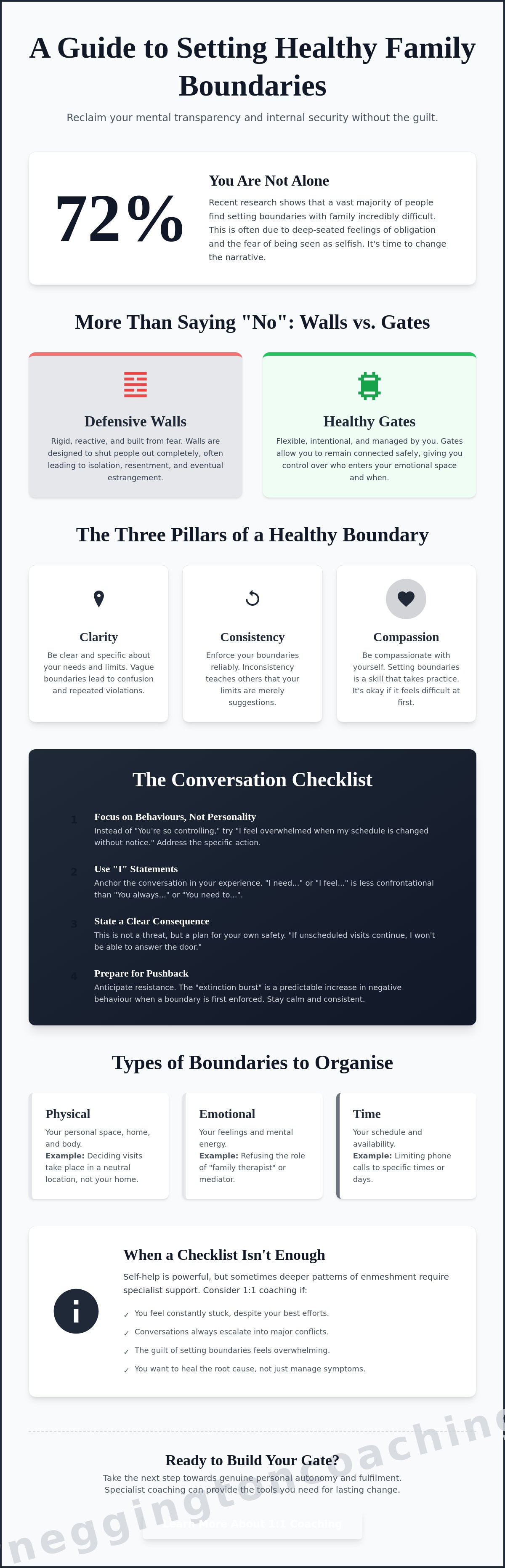
Have you ever felt that setting boundaries with family feels like an act of betrayal? For many, the word "boundary" suggests a cold, rigid barrier that exists only to keep people at a distance. However, understanding personal boundaries is actually about defining where you end and where your family begins. In an adult context, a boundary isn't a wall designed to shut people out; it's a gate. A wall often leads to estrangement and isolation. A gate, by contrast, allows you to remain in the relationship safely. It gives you the power to decide who enters your emotional space and under what conditions. This is the first step toward internal security.
Successful boundaries rest on three pillars: clarity, consistency, and compassion. You must be clear about your needs, consistent in your enforcement, and compassionate toward your own well-being. This is particularly challenging whilst living in a culture that prizes "politeness" over authenticity. We are often taught that being a "good" child means being compliant, but true maturity requires the courage to be honest instead of merely pleasant. You aren't being difficult; you are simply being clear. When you start setting boundaries with family, you are essentially teaching them how to love you without exhausting you.
The Internal Audit: Are Your Boundaries Leaking?
Before you can change your external reality, you must listen to your internal cues. Are you currently over-extending your emotional labour? You might be experiencing "emotional trespassing" if a parent or sibling assumes they have an automatic right to your mental energy at any time of day. Pay attention to your body. Boundary violations often manifest as a sudden tightness in the chest, a sinking feeling of dread when the phone rings, or a simmering resentment that lingers long after a conversation ends. These are not signs of a "bad" attitude. They are your internal security system telling you that your space has been breached. It is time to begin relinquishing external emotional burdens that were never yours to carry.
Do you feel responsible for managing a parent's loneliness or disappointment?
Do you say "yes" to family events whilst already feeling physically exhausted?
Do you find yourself rehearsing defensive arguments in your head for days before a visit?
Types of Boundaries You Might Need to Organise
To reclaim your peace, it helps to organise your limits into clear, logical categories. Physical boundaries might involve reclaiming your spare house keys or deciding that visits will now take place in a neutral centre rather than your own home. Emotional boundaries are equally vital. You might need to refuse the role of "family therapist" or mediator between feuding relatives. Finally, time boundaries protect your schedule. This could mean limiting phone calls to a specific evening or deciding that holiday stays will last two nights instead of five. By defining these areas, you move closer to a state of mental transparency, where your needs are no longer obscured by the demands of others.
The Boundary-Setting Checklist: Preparing for the Conversation
Entering a conversation about limits without a plan often leads to the very conflict you are trying to avoid. Preparation is about creating a sense of internal stability before the first word is spoken. When you begin setting boundaries with family, your primary objective is to address specific behaviours rather than attacking a person's character. Labelling someone as "controlling" or "toxic" only invites defensiveness; instead, focus on the action that causes distress. Choose a neutral time for this discussion, far removed from the high-tension environment of holiday dinners or family celebrations. This ensures that you are speaking from a place of mental lucidity rather than emotional exhaustion.
Your success depends on your ability to define the outcome you need while Overcoming Internal Barriers like guilt or fear. Use "I" statements to anchor the conversation in your own experience. For example, "I feel overwhelmed when..." is more effective than "You always...". Before you speak, decide on a realistic consequence. This isn't a threat; it's a plan for your own safety. If the boundary is ignored, you must be ready to use the "broken record" technique, calmly repeating your limit without being drawn into a debate. If you find yourself stuck in these cycles, exploring 1:1 coaching can provide the tailored support needed to hold these lines with confidence.
Scripting Your Needs: What to Actually Say
Clarity is kind. When you over-explain, you unintentionally invite the other person to negotiate your needs. Keep your scripts brief, certain, and direct. Use "soft start-ups" to signal that you value the relationship even whilst you are changing its dynamics. Here are three ways to handle common scenarios:
Unsolicited Advice: "I appreciate your concern, but I'm not looking for feedback on this right now. I need to handle this my own way."
Intrusive Questions: "I'm not comfortable discussing my finances today. Let’s talk about something else."
Phone Call Frequency: "I love catching up, but I can't answer calls during my workday. I'll call you on Sunday afternoon instead."
The "Consequence" Checklist
A boundary without a consequence is merely a suggestion. To protect your peace, focus entirely on what you will do, not what you demand they change. Your actions are within your control; their reactions are not. Ensure your plan is realistic and sustainable. Stating a consequence should feel like a neutral observation of a new rule, not an ultimatum meant to punish. If you cannot follow through, the boundary will not hold. Relinquish the external emotional burden of their reaction and focus on your own consistency.
If the topic changes to my weight, I will politely end the phone call.
If you arrive at my house without calling first, I will not be able to let you in.
If the conversation becomes a row, I will leave the room to protect my calm.
Handling the Pushback: A Checklist for Family Resistance
Why does it often feel as though things are falling apart just as you have finally started standing up for yourself? If your family reacts to your new limits with anger, tears, or cold silence, you are likely witnessing an "extinction burst." This is a psychological phenomenon where a person escalates their unwanted behaviour in a desperate attempt to return to the old status quo. When setting boundaries with family, the resistance you encounter isn't a sign that you have failed. Rather, it's proof that the boundary is actually working. You have stopped playing your assigned role, and the system is struggling to adjust to your new-found autonomy.
Resistance can manifest in several predictable ways. You might encounter gaslighting, where your reality is questioned; guilt-tripping, where your past is weaponised against you; or the "victim" role, where your parent's feelings are suddenly more important than the behaviour that caused the issue. If you have historically been the "Family Scapegoat," this pushback will feel particularly intense. Because the family relies on you to carry their collective tension, your refusal to do so forces them to face their own internal burdens. Staying grounded requires you to recognise that being called "difficult" or "selfish" is often just family code for "someone we can no longer control."
Navigating the Guilt-Trip
It is vital to distinguish between causing true harm and causing "uncomfortable growth." If a family member is upset because they can no longer access your bank account or interrupt your workday, you haven't harmed them; you have simply removed a privilege they were never entitled to. Reframe the narrative: you aren't "hurting" them, they are simply reacting to a healthy limit. During the "guilt storm," use these self-affirmations to maintain your mental transparency:
"I am responsible for my own peace, not for managing their disappointment."
"My boundaries are a requirement for my presence, not a punishment for theirs."
"I can be a loving person whilst still saying no."
The "Exit Strategy" for Family Gatherings
Maintaining your autonomy during visits requires practical planning. Always organise your own transport and accommodation; being dependent on a relative for a lift or a bed creates a power imbalance that makes boundaries harder to hold. Utilise a "Code Word" with a partner or a trusted friend that signals when a conversation has turned toxic and it’s time to leave the room. The most challenging part is often the "re-entry" anxiety, the fear of how you will be received the next time you see them after enforcing a limit. Remember that you don't need to apologise for your boundary. Re-enter the space slowly, focusing on your own internal security rather than seeking their approval for your new rules.
Deconstructing the "Good Child" Identity: Overcoming Internal Barriers
Why does the simple act of saying "no" feel like a fundamental betrayal of who you are? For many adult children, the difficulty of setting boundaries with family stems from a deep-seated state of parental enmeshment. This is a complex interpersonal dynamic where the emotional lines between you and your parents have become blurred, leaving you with a false, heavy, and exhausting sense of responsibility for their happiness. You weren't just raised to be a child; you were trained to be an emotional insurance policy. When you attempt to step out of this role, the internal resistance you feel is often the result of inherited beliefs that equate self-care with abandonment.
The "Good Child" trap is particularly insidious because it rewards you for being a "fixer." You may have spent decades mediating your parents' marriage or managing their moods, but this role is a significant barrier to your own personal growth. It prevents you from achieving mental transparency because your internal landscape is constantly cluttered by the needs of others. To move forward, you must learn to separate your self-worth from your family’s approval. Their disappointment is a reflection of their expectations, not a measurement of your value as a human being. If you feel stuck in these inherited patterns, you can book a 1:1 coaching session to begin the process of untangling your identity from these restrictive roles.
Reclaiming Your Identity
How do you begin to find yourself when the family "noise" is constant? Reclaiming your identity requires a deliberate audit of your values. In many British households, the "stiff upper lip" or a culture of polite compliance can obscure what you actually believe. You must find a sense of self that exists entirely outside of your family tree. This involves identifying which of your behaviours are driven by genuine desire and which are merely performances designed to keep the peace. Consider this checklist to find clarity:
Does this decision reflect my personal values or my family's expectations?
Am I acting out of love, or am I acting out of a fear of conflict?
Who would I be if I wasn't worried about their reaction?
Letting Go of the "Emotional Burden"
A vital step in your healing journey is acknowledging a difficult truth: you cannot fix your parents’ unhappiness, their marriage, or their past traumas. Relinquishing external emotional burdens is not an act of cruelty; it is an act of survival. You can choose to "detach with love," which means maintaining a connection whilst refusing to be pulled into their emotional crises. This preserves your mental health and allows you to show up as your most authentic self. I have an absolute right to personal autonomy without needing to apologise for my existence or my needs. By embracing this certainty, you create the space necessary for true fulfilment and internal security.
Moving Towards Clarity: When to Seek Specialist Support
Have you reached a point where checklists and scripts feel insufficient against the weight of your family history? Whilst self-help tools provide a vital foundation, deep-seated behavioural cycles often require a more nuanced approach. If you find yourself repeatedly setting boundaries with family only to have them crumble under the first sign of a guilt-trip, it may be time to seek a different level of support. Specialist family dynamics coaching differs from generic life coaching by focusing specifically on the intricate, often invisible threads of enmeshment and inherited roles that keep you stuck. It provides a structured, logical framework for healing that moves beyond surface-level advice.
A professional dialogue offers more than just a listening ear; it provides a secure refuge where you can examine high-stress interpersonal landscapes without judgment. When you engage in this process, you can expect a transition from confusion to mental transparency. This isn't about clinical diagnosis, but about practical strategies for reclaiming your emotional space. Through 1:1 coaching, you gain the tools to protect your peace whilst remaining grounded, solution-oriented, and certain. This personalised path ensures that the steps you take are sustainable and aligned with your unique personal values.
The Benefits of a Neutral Ally
An objective professional acts as a steady hand, helping you identify the "blind spots" that are impossible to see when you are in the centre of the storm. Within the family system, roles are often so entrenched that you may not even realise you are over-extending your emotional labour. Coaching helps you break these cycles of parental enmeshment for good by providing an impartial perspective. Instead of reacting to the latest family crisis, you learn to respond from a place of internal security. This shift is what allows you to move from simply surviving your family to truly thriving in your own life, separate from the roles you were assigned as a child.
Your Next Steps to Freedom
The journey toward personal fulfilment starts with a single, manageable step. To begin, try setting a 30-day goal for one specific boundary you wish to implement. This could be as simple as declining to discuss a specific topic or limiting the frequency of your phone calls. We invite you into a low-pressure introductory conversation to explore your situation and determine how to move forward with clarity. It is time for relinquishing external emotional burdens that have clouded your vision for years. By choosing professional guidance, you are choosing a future defined by personal autonomy, mental lucidity, and lasting peace.
Reclaiming Your Future and Protecting Your Peace
You have spent a lifetime responding to the needs of others, often at the cost of your own mental transparency. By defining your own "gates" and preparing for the inevitable pushback, you move away from the heavy weight of inherited guilt and toward a life of genuine personal autonomy. Setting boundaries with family is not a final act of separation; it is a necessary step toward building a relationship that respects your internal security and adult identity.
If the journey feels overwhelming, remember that you don't have to navigate these complex landscapes alone. Martyn Eggington Coaching provides specialist support for those navigating family estrangement and parental enmeshment, offering compassionate, non-judgemental guidance in London, Surrey, and online. With extensive experience in navigating high-stress interpersonal landscapes, this practice can help you find the clarity needed to hold your space with confidence. Book a low-pressure introductory conversation with Martyn Eggington Coaching to begin relinquishing the external emotional burdens you've carried for too long. You are worthy of a future defined by your own choices and a profound sense of inner tranquillity.
Frequently Asked Questions
How do I set boundaries with family without feeling guilty?
You manage guilt by recognising it as a byproduct of old conditioning rather than a sign of actual wrongdoing. When you begin setting boundaries with family, remind yourself that their discomfort is a necessary part of their own growth. You aren't responsible for their emotional reactions; you are only responsible for your own internal security. Relinquishing the external emotional burden of their disappointment is the first step toward true personal autonomy and peace.
What do I do if my parents ignore the boundaries I have set?
You must follow through with the pre-decided consequence immediately and consistently. If you stated you would end the call if a specific topic was raised, you must do so without further debate or apology. Boundaries are not about controlling their behaviour, but about controlling your own response to it. Consistency is the only way to teach others that your limits are firm, certain, and non-negotiable.
Is it possible to set boundaries with a manipulative family member?
It is possible by using the "broken record" technique and maintaining a neutral, objective distance. Manipulative individuals often seek an emotional reaction to regain control. By staying calm and repeating your limit without providing new information or justifications, you remove their leverage. This approach protects your mental transparency and prevents you from being drawn back into old, exhausting power dynamics that no longer serve your well-being.
Can I set boundaries with family without causing a permanent rift?
You can certainly establish limits whilst maintaining a connection, as boundaries are intended to be gates rather than walls. However, you must accept that you cannot control how they choose to respond to your new-found autonomy. Whilst some relatives may eventually adjust to the new dynamic, others may struggle. Your priority must remain your own internal security and the removal of emotional burdens that prevent your personal growth.
What are some examples of healthy boundaries with parents for adults?
Healthy examples include deciding to meet in a public centre rather than a private home or limiting phone calls to specific times of the week. You might also set limits on unsolicited advice regarding your career, finances, or parenting. Another vital boundary is refusing to mediate conflicts between other family members. These practical steps ensure that your time and emotional energy are used for your own fulfilment.
How do I explain my need for boundaries to family who don’t understand?
You explain your needs by using clear, concise "I" statements that focus on your own experience rather than their faults. For instance, "I need our visits to be shorter so I can return home feeling rested." Avoid the trap of over-explaining, as this suggests your needs are up for negotiation. A simple, firm statement of what you require is often the most compassionate way to communicate your new limits.
When is it time to consider family estrangement instead of just boundaries?
Estrangement is usually considered when your mental or physical safety is consistently at risk despite your best efforts at setting boundaries with family. If every interaction leaves you feeling drained, anxious, or diminished, the relationship may be beyond the help of simple limits. This is a deeply personal decision that often follows a long period of unsuccessful attempts to create a safe, balanced dynamic within the family system.
How can coaching help me with setting boundaries more than a book can?
Coaching provides a level of tailored, professional dialogue that a book simply cannot replicate. An objective ally helps you identify specific blind spots in your family dynamics and offers a secure refuge for you to practice your new skills. This 1:1 support moves you beyond theory into practical, lived experience, ensuring you have a steady hand to guide you through the most challenging moments of your healing journey.


Comments