

Parental Enmeshment Test: Assessing Your Family Dynamics for Emotional Clarity

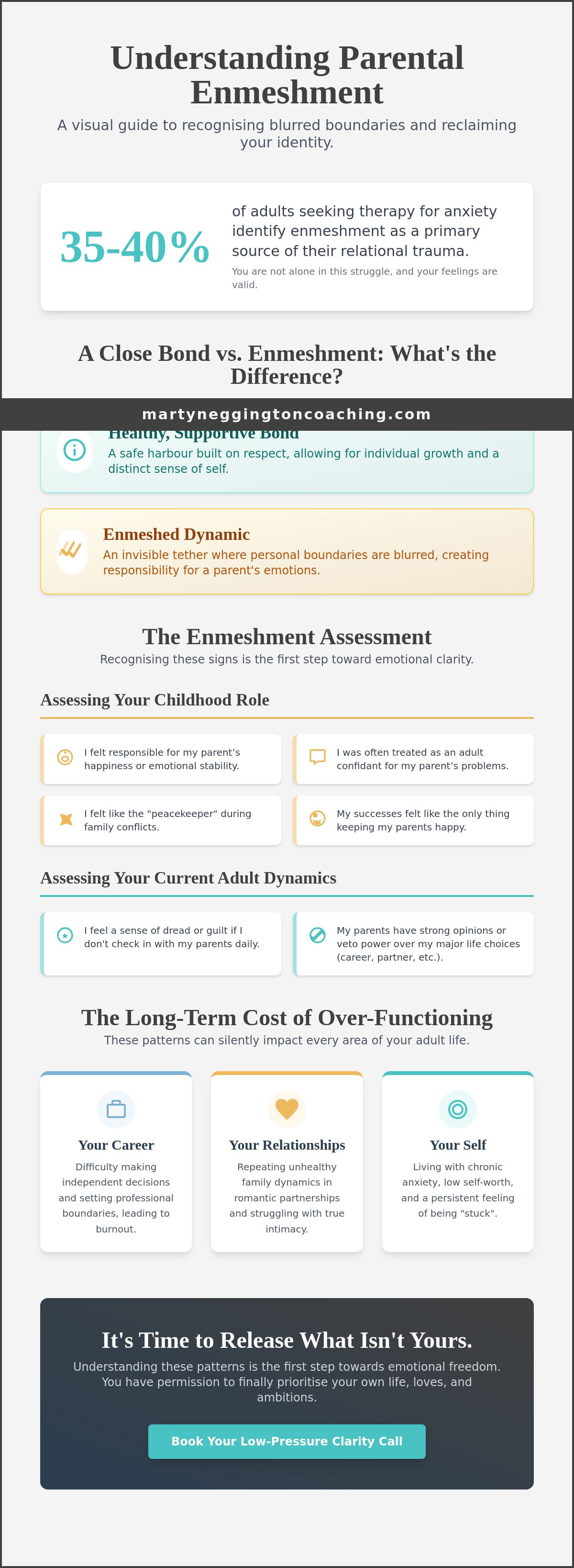
Have you ever felt that your own happiness is secondary to your parent's emotional stability? Perhaps you find yourself constantly managing their moods or feeling a heavy weight of guilt whenever you try to make a decision for yourself. Taking a parental enmeshment test isn't about judging your family's love; it's about finding a roadmap for your own transformation. Research indicates that 35 to 40% of adults seeking therapy for anxiety identify enmeshment as a primary source of their relational trauma. You are not alone in this struggle, and your feelings of being overwhelmed are entirely valid.
We understand how exhausting it is to lack a distinct sense of self outside the family unit. This article will help you assess your family dynamics to gain true emotional clarity. You'll discover if these lifelong patterns are hindering your personal growth and learn how to begin the journey toward emotional freedom. We will explore the framework of enmeshment and provide the permission you need to finally prioritise your own life, loves, and ambitions. It's time to release what isn't yours and step into a lighter, more authentic version of yourself.
Key Takeaways
Recognise that enmeshment is not a lack of love, but a blurring of boundaries that can leave you feeling responsible for a parent’s emotional stability.
Use our parental enmeshment test to identify 20 specific signs of blurred boundaries within your childhood and current adult life.
Move from confusion to emotional clarity by understanding that your results are a roadmap for transformation, not a clinical verdict on your family.
Understand the long-term cost of over-functioning and how these family patterns may be silently impacting your career and romantic relationships.
Discover how a low-pressure clarity call can help you release what isn’t yours and finally prioritise your own life and ambitions.
Table of Contents
The Invisible Tether: Why You Are Seeking a Parental Enmeshment Test
The Parental Enmeshment Assessment: 20 Signs of Blurred Boundaries
Deciphering Your Results: Moving from Confusion to Emotional Clarity
The Cost of Over-functioning: Why Addressing Enmeshment is Vital for Your Future
Reclaiming Your Identity: How Coaching Supports Your Journey
The Invisible Tether: Why You Are Seeking a Parental Enmeshment Test
Do you often feel like you are carrying an invisible weight that doesn't belong to you? Many people who search for a parental enmeshment test arrive here feeling a profound sense of guilt, as if even questioning their family dynamic is an act of betrayal. It's a heavy, suffocating sensation. You might feel responsible for your parent's emotional stability, or perhaps you find it impossible to make a career move without wondering how it will affect them. This is the "Invisible Tether" in action. It is not a sign that you are a bad person; rather, it is a sign that your boundaries have become blurred over time.
The psychological concept of enmeshment describes a family system where personal boundaries are permeable and poorly defined. It's vital to understand that enmeshment is rarely born from a lack of love. In fact, it often looks like "too much" love, but without the necessary space for individual growth. In the United Kingdom, our cultural "stiff upper lip" often masks these dynamics. We're taught to "just get on with it", which can lead us to ignore the internal alarm bells that tell us something is wrong. By seeking out a parental enmeshment test, you're choosing to look past social expectations and find the truth of your own experience.
Signs You Are "Over-functioning" for Your Parents
Over-functioning often begins in childhood, particularly if you were the "favourite" or the "most talented" child. Whilst these titles sound positive, they often come with an unspoken requirement to meet a parent's unfulfilled dreams. You might have found yourself acting as your parent's primary confidant or "best friend", a role that forces a child to manage adult emotions before they're ready. This creates a lifelong pattern where you feel a crushing sense of guilt for simply spending time away from the family home or prioritising your own partner and ambitions.
The Difference Between a Close Bond and Enmeshment
A healthy family should be a safe harbour, a place you return to for support whilst maintaining your own distinct identity. Enmeshment, however, feels more like a storm where you're constantly trying to keep the ship from sinking. This dynamic often involves emotional parentification, where the roles are reversed and you become the caregiver for your parent's psyche. Reaching a state of Emotional Clarity allows you to distinguish between genuine care and a tether that holds you back. The goal isn't to destroy the relationship, but to release what isn't yours so you can finally breathe.
The Parental Enmeshment Assessment: 20 Signs of Blurred Boundaries
It takes a great deal of courage to look closely at the invisible threads that bind you to your family. If you've felt a persistent sense of unease or a lack of personal space, this parental enmeshment test serves as a mirror for your experiences. It's not a clinical diagnosis, but a way to provide a name for the weight you've been carrying. As you read through these statements, I invite you to breathe deeply and remain non-judgmental. Recognising these parental enmeshment signs is the first step toward finding your own safe harbour.
Assessing Your Childhood Role
Reflect on your younger years. Did you feel like a child, or were you an emotional anchor for the adults around you? Consider if these statements resonate with your past:
I felt responsible for my parent’s happiness or emotional stability.
I was often treated as an adult confidant for my parent’s problems.
I felt I had to put my own needs aside to protect a parent’s feelings.
My parents shared inappropriate details about their romantic or financial lives with me.
I felt like the "peacekeeper" during every family conflict.
I was praised for being "mature for my age" because I managed my parents' moods.
I felt that my successes were the only thing keeping my parents happy.
Assessing Your Current Adult Dynamics
Enmeshment doesn't disappear when you move out; it often evolves into subtle forms of control and over-functioning. How do you interact with your parents today?
I feel a sense of dread or guilt when I don’t check in with my parents daily.
My parents have strong opinions or veto power over my romantic partners.
I struggle to make decisions without imagining my parent’s reaction first.
I feel I must "filter" my life updates to avoid upsetting my parents.
My parents expect me to drop everything to help them with minor emotional crises.
I find it difficult to say "no" to family gatherings, even when I'm exhausted.
I feel like I'm betraying my family if I keep certain parts of my life private.
Assessing the Emotional Cost
Finally, consider the internal impact of these dynamics. How does this connection affect your sense of self?
I feel lighter and more like myself when I am physically far away from my family.
I often feel like a "bad person" for wanting to live my own life or pursue my own dreams.
I struggle to identify my own ambitions outside of family expectations.
I feel a physical sensation of tension or "tightness" in my chest when my phone rings with their name.
I find it hard to trust my own instincts because I've always relied on their approval.
I feel like I don't truly know who I am when I'm not playing a role for my family.
If these points feel heartbreakingly familiar, remember that you aren't alone. Identifying these patterns through a parental enmeshment test is the beginning of your journey toward Emotional Clarity. You might find it helpful to discuss these reflections in a confidential space during a 30-minute clarity call, where we can begin to untangle these tethers together.
Deciphering Your Results: Moving from Confusion to Emotional Clarity
Completing a parental enmeshment test can feel like opening a door you have kept locked for a lifetime. It is common to feel a rush of conflicting emotions, ranging from relief to a sharp, stinging sense of betrayal. Please know that there is no "pass" or "fail" here. These results aren't a verdict on your character or a final judgement on your family's love. Instead, they provide a necessary framework to help you move from a state of unresolved confusion toward true Emotional Clarity. Identifying these patterns is the vital first step in shedding the burden of emotions that simply do not belong to you.
Understanding the "Mild" to "Deep" Enmeshment Spectrum
Enmeshment exists on a spectrum. Understanding where your family dynamic sits helps you tailor your approach to healing. Whilst every family is unique, most results fall into three broad categories that describe the strength of the invisible tether.
Regardless of where you fall on this spectrum, change is entirely possible. Even deep-seated patterns can be unlearned once they are brought into the light. The goal is to move toward a future where you are free to concentrate on your own ambitions without the constant hum of family-induced anxiety.
Why Your "Score" is Only the Beginning
Identifying the signs of parental enmeshment acts as a catalyst for personal transformation. It is perfectly normal to feel an immediate wave of guilt after "admitting" that your family dynamic is unhealthy. You aren't being a "bad person" for wanting to understand the effects of enmeshment on your development. In fact, acknowledging these truths is the most compassionate thing you can do for yourself and your future.
This parental enmeshment test provides the objective distance you need to stop over-functioning for others. Once you see the pattern, you can't "un-see" it. This awareness allows you to begin the process of differentiation, where you learn to stand as a distinct individual. You are beginning to release the weight of expectations that were never yours to carry. This is not about cutting people out; it is about bringing yourself back in.
The Cost of Over-functioning: Why Addressing Enmeshment is Vital for Your Future
Ignoring the patterns revealed by a parental enmeshment test carries a heavy long-term price. When your emotional energy is constantly diverted toward managing a parent's life, your own future begins to pay the interest. Research indicates that enmeshed family systems are associated with anxiety rates as high as 68% in clinical populations. This isn't just a "family quirk"; it is a significant barrier to your professional success and romantic stability. If you are always looking over your shoulder for a parent's approval, you cannot keep your eyes on your own path.
Many people believe it's too late to change these lifelong dynamics, especially if they have reached their 30s, 40s, or beyond. This is a misconception that keeps many adult children stuck in a cycle of over-functioning. While the past is fixed, your future remains yours to reclaim. Addressing these blurred boundaries now prevents you from slipping into "absent parent syndrome" in your own life. When you are emotionally consumed by your parents, you are often unavailable for your own children or partner, inadvertently passing the tether down to the next generation. You have the power to be the one who breaks this cycle.
The Impact on Your Own Identity and Ambitions
Enmeshment acts as a ceiling on your personal growth. If you've ever turned down a promotion because it would take you further from your parents, or stayed in a stagnant job to remain "available" for their crises, you've experienced the professional cost of over-functioning. This constant state of high-alert leads directly to burnout. It's heartbreaking to realise how much of your potential has been traded for a parent's temporary comfort. Reclaiming the freedom to concentrate on your own loves and ambitions is not a selfish act; it's a necessary step toward becoming the person you were meant to be before the enmeshment took hold.
Breaking the Cycle: From Guilt to Freedom
Dismantling the belief that setting boundaries is an act of betrayal is the hardest part of this journey. You might feel like a "bad person" for wanting space, but remember: healthy love does not require the sacrifice of your identity. By choosing to release what isn't yours, you aren't abandoning your family; you're simply handing back the emotional burdens they should have carried themselves. This process creates a "safe harbour" within yourself, allowing you to find a sense of calm that isn't dependent on a parent's mood. It is a progressive journey from the heavy weight of the past toward a life of transformation.
If you're ready to stop over-functioning and start living for yourself, the first step is gaining professional feedback on your situation. You can book a 30-minute clarity call to discuss your family dynamics in a confidential, non-judgmental space and begin the process of shedding these invisible burdens.
Reclaiming Your Identity: How Coaching Supports Your Journey
After completing a parental enmeshment test, you might feel as though you are standing at a significant crossroads. You have identified the invisible tethers and acknowledged the weight of over-functioning, but the path toward a different future can still feel obscured by fog. This is where the distinction between coaching and therapy becomes vital. Whilst clinical psychotherapy often focuses on the deep-seated "why" of childhood wounds, coaching is a pragmatic, future-focused discipline. It is designed to help you answer the question: "What do I do now?"
Martyn Eggington Coaching provides a safe harbour for this transition, offering the professional stability you need when family dynamics feel like a storm. As an objective ally, Martyn isn't emotionally invested in your family conflict; he is solely committed to your personal growth. This "YOU first" mentality is often the first time many adult children have felt truly advocated for. The process is about moving from a state of being "tethered" by guilt to being "free" to pursue your own ambitions, loves, and interests without seeking permission from those who cannot give it.
The Pragmatic Guide to De-enmeshment
Working through 1:1 coaching allows you to organise your thoughts and develop a concrete plan for change. It isn't enough to simply know you are enmeshed; you need the tools to navigate the daily reality of that dynamic. Coaching provides constructive feedback on how to handle difficult conversations and set firm, compassionate boundaries. By learning how to break enmeshment, you begin to shed the burdens that were never yours to carry. This isn't about being a "bad person"; it's about becoming a whole person who is no longer defined by a parent's emotional needs.
Your First Step: The 30-Minute Clarity Call
The journey toward Emotional Clarity doesn't have to be a lonely or overwhelming endeavour. The 30-minute clarity call serves as a low-pressure, confidential entry point where you can discuss the results of your parental enmeshment test with an experienced professional. In this space, your pain is acknowledged as heartbreaking, but the focus remains grounded and solution-oriented. You'll receive a steady hand to guide you through the "lifelong patterns" that have kept you stuck, moving you toward a genuine life transformation.
This initial conversation is a compassionate space to explore what your life could look like if you were no longer managing everyone else's happiness. It is an invitation to release what isn't yours and finally step into the light of your own life. If you're ready to find inner safety and calm, book your 30-minute Clarity Call today and take the first step toward a future where you come first.
Step Into Your Own Life with Emotional Clarity
Moving from the heavy fog of family expectations into the light of your own life is a profound transformation. By engaging with the parental enmeshment test, you've already taken the most difficult step: admitting that something needs to change. You now understand that your feelings of guilt and over-functioning aren't personal failings; they're symptoms of blurred boundaries that have persisted for years. It's time to release what isn't yours and focus on your own ambitions.
As a specialist in family estrangement and enmeshment, I provide a safe harbour for those ready to shed these burdens. My practice is built on being Confidential | Compassionate | Experienced, serving clients across London, Surrey, and West Sussex with flexible online options. You don't have to navigate this transition alone or feel that you're a bad person for wanting freedom. The path to Emotional Clarity is a progressive journey that prioritises your personal safety and inner calm.
The first step toward a lighter future begins with a single conversation. I invite you to book a 30-minute clarity call to discuss your results and start your journey toward a more authentic version of yourself. You deserve to live a life that is truly your own.
Frequently Asked Questions
What is the main difference between being close to a parent and being enmeshed?
A close bond is a safe harbour where you feel supported whilst maintaining a distinct sense of self and independent ambitions. In contrast, enmeshment involves a blurring of boundaries where your emotional state is dictated by your parent’s needs. If you find your own happiness is secondary to their stability, you are likely experiencing enmeshment rather than simple closeness. Differentiation is the goal of any parental enmeshment test, allowing you to be connected without being consumed.
Can parental enmeshment happen even if my parent is well-meaning?
Enmeshment is rarely born from malice; it often arises from a parent's own unresolved trauma or an intense, misplaced desire to protect. A well-meaning parent may believe they are being supportive whilst actually over-functioning for you. This creates a smothering effect that stifles your personal growth and independent identity. Recognising this dynamic doesn't mean your parent is a bad person; it simply means the current structure of the relationship is no longer healthy for your adult life.
Is it possible to fix enmeshment without cutting off my family entirely?
Healing from enmeshment doesn't always require a total cut-off or permanent estrangement. The objective is differentiation, which involves developing a clear sense of self and establishing firm boundaries whilst remaining in contact. You learn to release what isn't yours emotionally. Whilst some situations may eventually require distance for safety, many people successfully transition to a structured contact model that allows them to prioritise their own lives, loves, and ambitions without ending the relationship.
How much does family estrangement coaching differ from traditional psychotherapy?
Traditional psychotherapy often focuses on the "why" by exploring childhood wounds in a clinical, retrospective setting. Coaching with Martyn Eggington is future-focused and pragmatic, designed to help you organise your thoughts and take specific, goal-oriented actions. We focus on constructive feedback and real-time strategies for de-enmeshment. It is an objective allyship that moves you from the heavy weight of the past toward a genuine life transformation and a sense of inner calm.
Why do I feel so much guilt even when I know the relationship is unhealthy?
You feel guilt because you've been conditioned to believe that your parent’s happiness is your personal responsibility. This is the "Invisible Tether" at work. Research into relational trauma suggests that guilt is the primary tool used to maintain enmeshed systems and prevent independent decision-making. It's a physiological response to breaking a lifelong pattern. Part of the healing process is learning to tolerate this discomfort whilst you shed the emotional burdens that don't belong to you.
What happens if my parent reacts badly to me setting new boundaries?
If a parent reacts badly to your new boundaries, it often confirms the depth of the enmeshment. They may use guilt or anger to pull you back into your old role of emotional support. Coaching provides you with a safe harbour to process these reactions without folding. You'll learn that their emotional response is not your burden to fix. Staying calm and consistent is key to maintaining your inner safety and protecting your new-found emotional clarity.
Can coaching help me if I have already read all the books on enmeshment but still feel stuck?
Many clients have read the books and watched the videos but still feel tethered to old, painful patterns. This happens because intellectual understanding doesn't automatically lead to emotional release. Coaching provides the 1:1 accountability and personalised feedback required to move from insight to action. We work together to apply these concepts to your specific family dynamic, ensuring you don't just understand the parental enmeshment test results but actually begin to live free from them.
Do you offer online coaching for parental enmeshment outside of London and Surrey?
Yes, online coaching via Zoom is available for individuals regardless of their physical location. Whilst I serve many clients in London, Surrey, and West Sussex for in-person sessions, the majority of my work is conducted through digital platforms. This ensures that anyone seeking a parental enmeshment test and subsequent support can access a confidential and compassionate space. You can book a 30-minute clarity call from anywhere in the world to begin your journey toward emotional freedom.



Comments